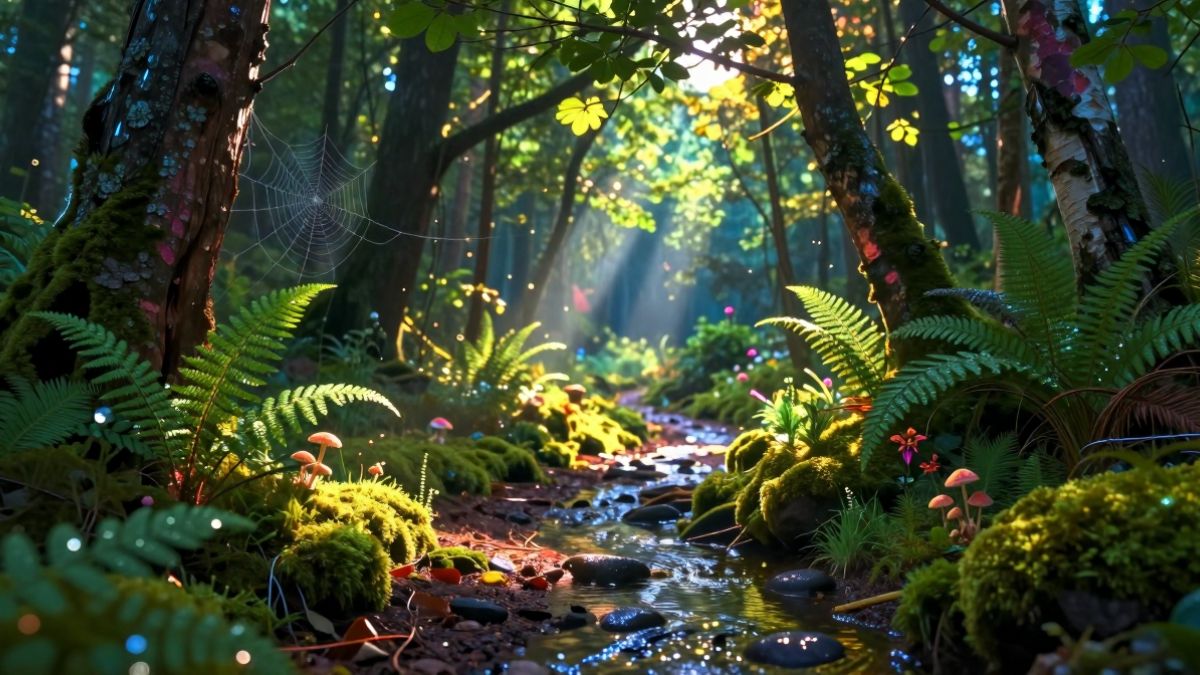
There’s a moment that happens about fifteen minutes into a forest walk—when the chatter in your mind finally goes quiet, and something older takes over. Your breath syncs with the rustle of leaves. Your heartbeat slows to match the pulse of the earth beneath your feet. The Japanese have a word for this: Shinrin-yoku, or “forest bathing.” And what they discovered centuries ago, modern science is only now beginning to understand: the forest isn’t just a place you visit—it’s a healer that rewires your entire being.
As we move into 2026, the practice of intentional forest immersion is experiencing a profound renaissance across India. From the Western Ghats to the forests of Uttarakhand, people are rediscovering what our ancestors always knew: that trees hold medicine the pharmaceutical industry cannot replicate.
The sacred contract between human and forest
The relationship between humans and forests has never been simple. It’s primal, mysterious, and deeply spiritual. We are not separate from the forest—we are extensions of it. Every inhale we take is a gift from the trees; every exhale feeds them in return. This exchange isn’t metaphorical. It’s biochemical, energetic, and sacred.

Ancient Indian texts recognized forests as tapovanas—sacred groves where sages meditated and received divine knowledge. The Upanishads were written in forest ashrams. The Buddha attained enlightenment under the Bodhi tree. Even today, tribal communities across India maintain a reverence for forest spirits and tree deities, understanding what urban civilization has forgotten: the forest is conscious, and it responds to those who approach with respect.
What the Japanese discovered (and why it matters for you)
In the 1980s, Japanese researchers began studying why people who spent time in forests reported profound shifts in mood, energy, and health. What they found was revolutionary:
- Phytoncides: Trees emit organic compounds that boost human immune function by up to 50% within just three days of forest exposure
- Negative ions: Forest air contains higher concentrations of negative ions, which reduce stress hormones and increase serotonin levels
- Biophilic resonance: Our nervous systems instinctively calm when surrounded by natural fractals—the patterns found in branches, leaves, and forest canopies
But here’s what Western science still struggles to measure: the energetic exchange. Practitioners of Shinrin-yoku describe feeling “seen” by the forest. They report heightened intuition, spontaneous emotional releases, and a sense of being held by something infinitely patient and wise.

Why your soul is starving without forest time
If you’ve been feeling disconnected, anxious, or spiritually hollow, your body is likely crying out for what the forest provides. Modern life—especially in Indian metros like Mumbai, Delhi, and Bangalore—creates a bioenergetic deficit. We’re surrounded by concrete, electromagnetic frequencies, and artificial light. Our circadian rhythms are disrupted. Our nervous systems are perpetually in fight-or-flight mode.
The forest offers the antidote:
- Grounding: Walking barefoot on forest soil discharges accumulated stress and electromagnetic toxicity
- Silence that speaks: The absence of human noise allows your inner voice to emerge
- Temporal freedom: In the forest, clock time dissolves. You enter “forest time,” where healing happens on nature’s schedule, not your calendar’s
How to practice sacred forest immersion
This isn’t about hiking for exercise or ticking off a nature checklist. Shinrin-yoku is a meditation in motion. Here’s how to honor the practice:

Before entering:
- Set an intention. Ask the forest for permission to enter its space
- Leave your phone on silent (or better, behind)
- Come with no agenda except presence
While inside:
- Walk slowly. Slower than feels natural
- Use all five senses. Touch bark. Smell the earth. Listen to bird calls
- Find a tree that calls to you. Sit with your back against it for at least twenty minutes
- If emotions arise—grief, joy, anger—let them move through you. The forest can hold it all
After leaving:
- Bow in gratitude
- Notice how your body feels different
- Commit to returning. The forest remembers you
The forests of India are calling you home
You don’t need to travel to Japan to access this medicine. India is blessed with extraordinary forest ecosystems: the sacred groves of Kerala, the sal forests of Jharkhand, the alpine forests of Himachal Pradesh, the rain forests of the Northeast. Each forest has its own personality, its own frequency.
What matters most is consistency. A weekly forest visit does more for your spiritual and physical health than a month of supplements or self-help books. The forest doesn’t judge your past or worry about your future. It simply invites you back into the present moment—into the truth of who you were before the world taught you to forget.
As 2026 unfolds, consider making forest bathing your non-negotiable spiritual practice. Not as escape, but as homecoming. Because the forest has been waiting for you. And it always will be.