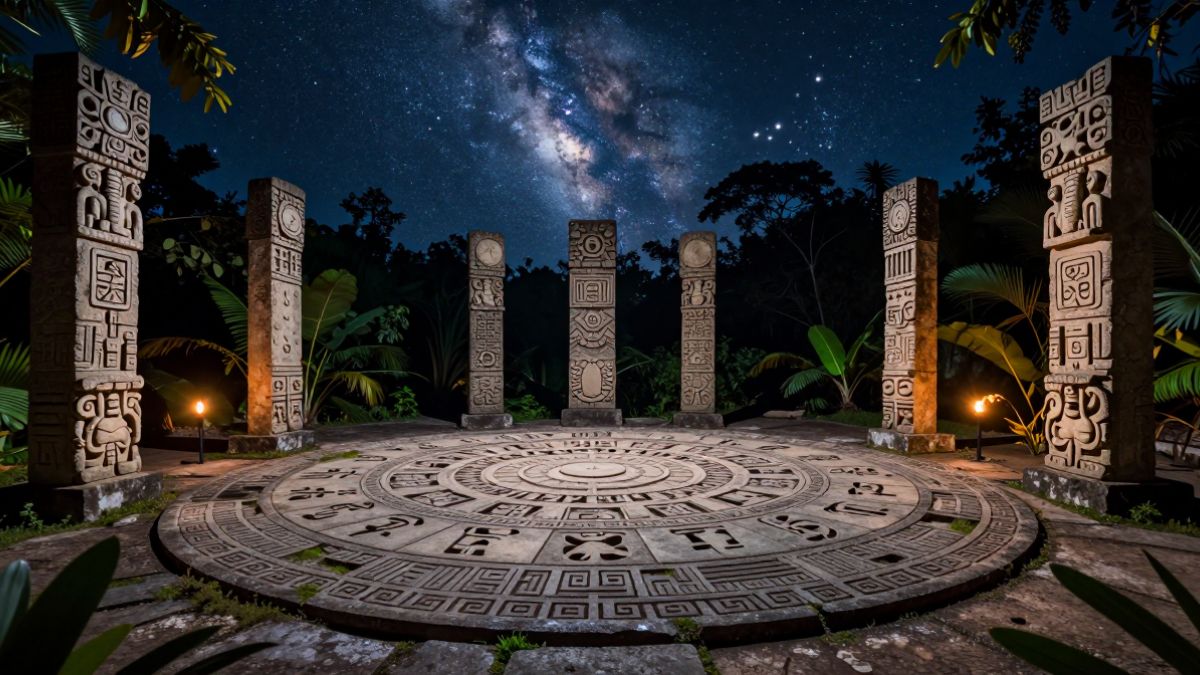
Across India and the world, a quiet but unmistakable shift is happening. People are turning away from their daily horoscopes and diving into something older, stranger, and far more intricate: Mayan astrology. And at the heart of this resurgence is a single year—2026.
Search interest for “Mayan astrology 2026” has spiked in recent months, and it’s not hard to see why. As we move deeper into December 2025, a growing number of seekers are asking: What did the ancient Maya know that we’ve forgotten? And why does 2026 keep appearing in spiritual circles as a year of transformation?
The cultural comeback of ancient systems
Mayan astrology isn’t new, but its return to mainstream consciousness feels different this time. Unlike the broad-stroke sun signs of Western astrology, the Mayan system is based on the Tzolk’in, a 260-day sacred calendar that weaves together 20 day signs and 13 galactic tones. Each person is assigned a unique combination at birth, creating a deeply personal spiritual blueprint.
This complexity is part of the appeal. In a world oversaturated with generic advice and algorithm-driven content, people are craving systems that feel personal, ancient, and unfiltered. Mayan astrology offers that. It doesn’t promise easy answers. It asks you to sit with cycles, honor time as sacred, and see yourself as part of a cosmic rhythm that predates modern civilization.
The resurgence also mirrors a broader cultural hunger for indigenous wisdom. As climate anxiety, political instability, and digital burnout intensify, many are looking to pre-colonial knowledge systems—not as escapism, but as grounding. The Maya understood time as cyclical, not linear. They saw endings as beginnings. That perspective feels urgently relevant as we navigate our own uncertain era.

Why 2026 has become a focal point
So why 2026? The answer lies in interpretation, prophecy, and the human need for milestones.
Some Mayan calendar researchers point to long-count cycles and suggest that 2026 marks a significant energetic threshold—a continuation of the shift many believed began in 2012. While the 2012 “end of the world” narrative was widely debunked, many spiritual communities reframed it as the start of a new era, not an apocalypse. In this view, 2026 represents a deepening of that transition.
Others highlight astronomical alignments expected around 2026, including rare planetary configurations that echo patterns the Maya tracked with precision. Whether or not these alignments hold metaphysical weight, they provide a symbolic anchor—a reason to pause, reflect, and recalibrate.
There’s also a psychological component. Humans love round numbers and temporal markers. 2026 feels close enough to prepare for, but far enough to project hope onto. It’s a canvas for intention-setting, a collective bookmark in time.
For those already exploring Mayan astrology, 2026 is less about prophecy and more about personal alignment. It’s a year to check in: Are you living in harmony with your day sign? Are you honoring your galactic tone? Are you moving with the cycles, or against them?
What draws people back to the Tzolk’in
The mechanics of Mayan astrology are intricate, but the emotional pull is simple: it makes you feel seen.
Unlike Western astrology, which often focuses on personality traits and compatibility, Mayan astrology emphasizes purpose and path. Your day sign isn’t just a label—it’s a mission. If you’re born under the sign of Ix (Jaguar), for example, you’re called to explore the mysteries, to walk between worlds, to trust your instincts. If you’re a Kan (Seed), your work is about growth, potential, and nurturing what wants to emerge.
This sense of cosmic assignment resonates deeply in a time when many feel adrift. It offers structure without rigidity, meaning without dogma.
Another draw: the calendar itself is a daily practice. Tracking the Tzolk’in means engaging with time as sacred. Each day has a unique energy. You learn to move with it, not against it. This isn’t passive consumption—it’s active participation.
And then there’s the aesthetic. The glyphs, the mythology, the connection to pyramids and jungle temples—it all carries a visual and narrative richness that feels worlds apart from the sterile minimalism of modern life. Mayan astrology invites you into a story, and that story feels alive.

How to explore Mayan astrology yourself
If you’re curious, here’s where to start:
- Calculate your Mayan day sign. Use a reputable online Tzolk’in calculator (input your birth date). Your sign and tone will reveal your core energy and life path.
- Study the 20 day signs. Each has its own symbolism, strengths, and challenges. Read about yours with an open mind.
- Track the daily energies. Many Mayan astrology practitioners share daily Tzolk’in readings. Follow along for a lunar cycle and notice patterns.
- Read foundational texts. Books like The Mayan Oracle by Ariel Spilsbury and Jaguar Wisdom by Kenneth Johnson offer accessible entry points.
- Engage with indigenous voices. Seek out teachers and authors with direct ties to Mayan traditions. Respect the lineage.
This isn’t about replacing your current spiritual practice—it’s about adding depth, nuance, and a different lens.
The bigger picture: astrology as social mirror
The rise of Mayan astrology in 2025 and the fixation on 2026 tell us something important about where we are collectively. We’re searching for meaning in systems that predate capitalism, colonization, and the attention economy. We’re hungry for practices that ask us to slow down, to look up, to remember that we are part of something vast and cyclical.
Whether or not you believe in astrology—Mayan or otherwise—the trend itself is worth paying attention to. It reflects a desire for reconnection: to time, to the cosmos, to lineages that honored both.
As 2026 approaches, the question isn’t whether the Maya “predicted” something. It’s whether we’re willing to listen to what their wisdom still has to teach us. And that answer, like the Tzolk’in itself, unfolds one day at a time.