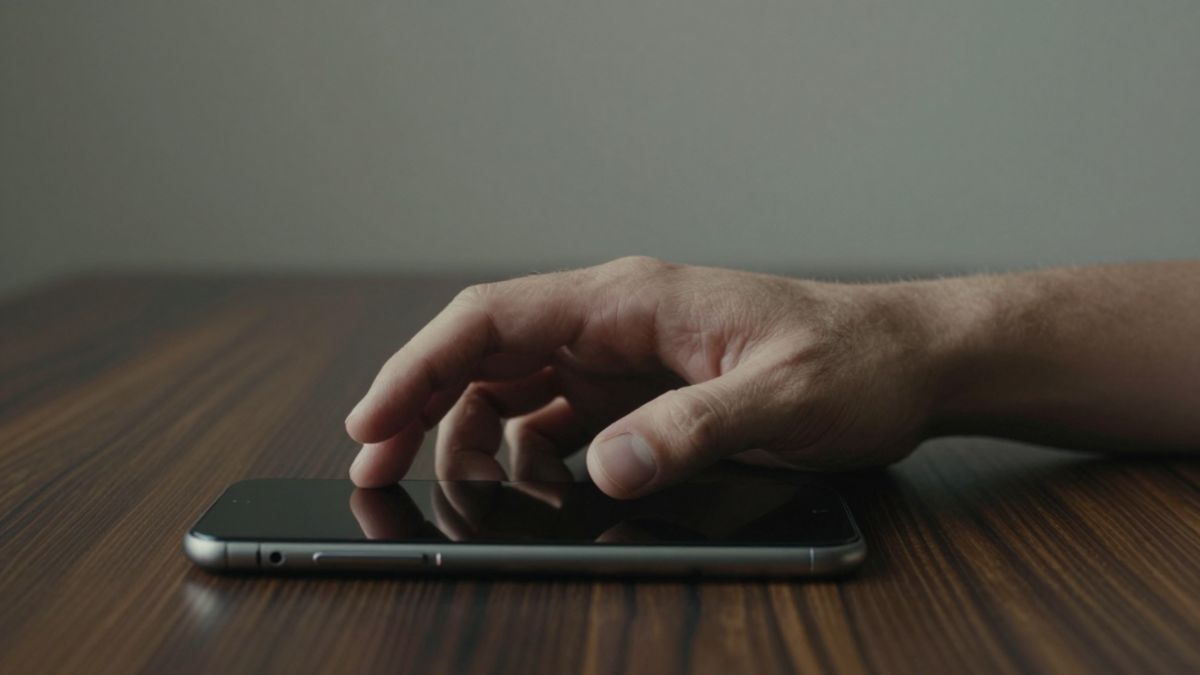
You’re sitting at your desk, phone on silent across the room, when you feel it: that unmistakable buzz against your thigh. You reach down. Nothing. The screen is dark. Your pocket is empty. Welcome to phantom vibration syndrome, and if you’ve noticed it getting worse lately, you’re not imagining things.
Research suggests that up to 90% of smartphone users experience phantom vibrations at least occasionally. But here’s the uncomfortable truth: the more you check your phone, the more your brain invents reasons to check it again. It’s a feedback loop, and seven tiny habits are quietly training your nervous system to feel buzzes that never happened.
The feedback loop: Checking trains your brain
Every time you pull out your phone “just to see,” you’re reinforcing a neural pathway. Your brain begins to associate certain body sensations—muscle twitches, fabric shifts, even your heartbeat—with incoming notifications.
Think of it like Pavlov’s dogs, except you’re both the dog and the bell. The more frequently you check, the more sensitive your brain becomes to any tactile input near your phone’s usual location. Within weeks, random nerve firings start feeling like urgent alerts.
This isn’t a character flaw. It’s classical conditioning, and it happens automatically. The good news? Conditioning can be reversed with deliberate habit changes.

Pocket and posture triggers
Where you keep your phone matters more than you think. Certain placements create constant low-grade stimulation that primes your brain for false alarms.
High-risk positions:
- Front pocket while sitting (pressure + movement)
- Tight back pocket (fabric tension mimics vibration)
- Waistband or bra strap (elastic pressure shifts constantly)
- Always in the same spot (brain maps that exact location)
Posture compounds the problem. Slouching compresses your phone against your body, creating micro-movements your brain interprets as vibrations. Crossing your legs changes pressure distribution. Even breathing deeply can shift fabric enough to trigger a false alert.
Simple fix: Rotate where you carry your phone every few days. If it’s usually in your right pocket, move it to a bag or jacket. Break the location-expectation link.
Notification hygiene checklist
Most people carry around 40+ apps capable of sending alerts. Each one is a potential trigger, even when notifications don’t actually arrive—because your brain is constantly anticipating them.
Run this audit today:
- Open your phone’s notification settings
- Disable alerts for any app you haven’t actively used in the past week
- Turn off vibration for non-urgent apps (social media, news, shopping)
- Keep vibration only for calls and messages from actual humans
- Switch promotional emails to silent delivery
The goal isn’t to disconnect entirely. It’s to reduce the noise floor so your brain stops treating every sensation as a potential alert. When you receive fewer real vibrations, you’ll experience fewer phantom ones.

Replace the check ritual
Here’s where most advice fails: telling you to “just check less” without giving you something to do instead. Your brain hates a vacuum. You need a replacement behavior.
The breath-cue protocol:
When you feel a phantom vibration, don’t reach for your phone. Instead:
- Take one deep breath (4 seconds in, 6 seconds out)
- Notice the sensation without acting on it
- Ask yourself: “Did I actually feel something, or did I expect to?”
This 10-second pause breaks the automatic reach. Over time, it retrains your brain to distinguish real vibrations from false alarms.
Time-boxed checking:
Set three specific times each day to check notifications: morning, midday, evening. Outside those windows, your phone stays face-down or in a bag. No exceptions for the first 48 hours.
This isn’t about willpower. It’s about predictability. When your brain knows exactly when the next check happens, it stops inventing emergencies in between.
A 48-hour experiment to measure improvement
Commit to this protocol for just two days. Track your phantom vibrations using a simple tally system.
Day 0 (baseline):
- Carry your phone normally
- Every time you feel a phantom vibration, make a mental note
- At the end of the day, estimate the count
Days 1–2 (intervention):
- Move your phone to a different location
- Disable non-essential vibrations
- Use the breath-cue protocol
- Check only at your three scheduled times
- Track phantom vibrations again
Most people report a 30–50% reduction within 48 hours. The phantom sensations don’t vanish entirely—your nervous system needs more time to fully recalibrate—but the frequency drops noticeably.

Why this matters beyond the annoyance
Phantom vibrations aren’t just a quirky modern phenomenon. They’re a symptom of hypervigilance, a state where your nervous system is constantly scanning for threats (or in this case, notifications).
Chronic hypervigilance correlates with elevated cortisol, disrupted sleep, and difficulty concentrating on deep work. When your brain is always half-listening for a buzz, it can’t fully commit to the task in front of you.
Reducing phantom vibrations isn’t about being a digital minimalist or rejecting technology. It’s about reclaiming your attention from a feedback loop you never consciously agreed to.
Start with one habit tonight
You don’t need to overhaul your entire relationship with your phone by tomorrow morning. Pick the single habit from this list that feels most doable:
- Move your phone to a new pocket or bag
- Disable vibration for three non-urgent apps
- Set your first time-boxed check window for tomorrow
- Practice the breath-cue protocol once
Phantom vibrations trained your brain gradually, through thousands of micro-repetitions. Untraining happens the same way: one small, deliberate choice at a time. The buzz you didn’t feel is already losing its power.